
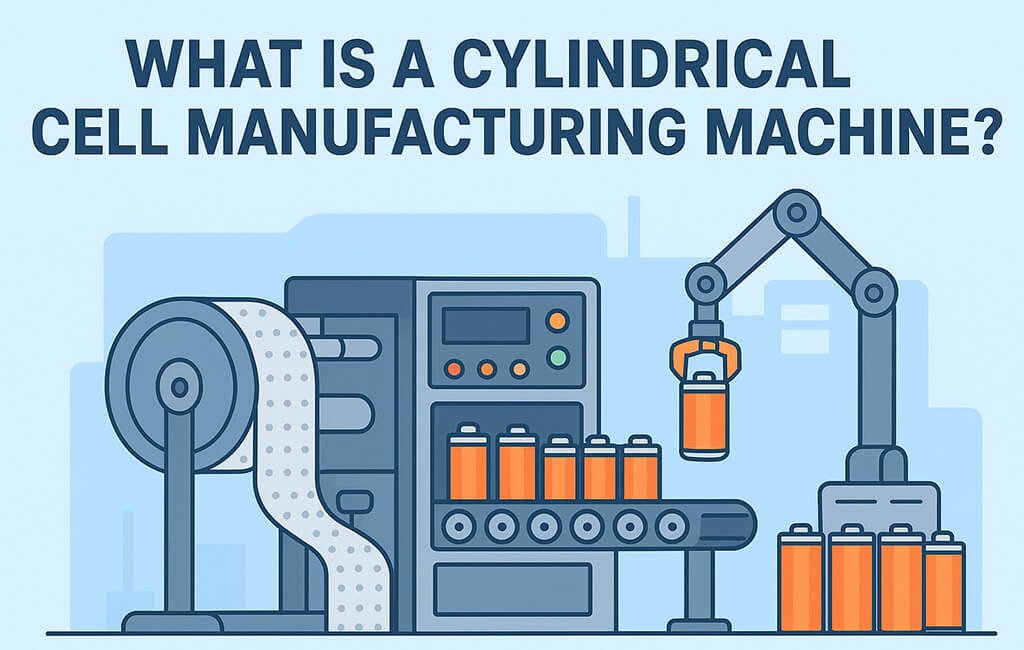
A cylindrical cell manufacturing machine encompasses the integrated equipment systems required to produce cylindrical battery cells, from electrode preparation through final testing. These machines combine precision mechanical systems, automated controls, and quality monitoring to manufacture cells ranging from 18650 format to larger 4680 configurations.
The production line typically includes electrode slitting machines, winding equipment, tab welding systems, electrolyte filling stations, and formation/testing units. Each subsystem operates within strict tolerances to ensure consistent cell performance and safety specifications.
Core Components of Cylindrical Cell Manufacturing Machine Systems
The electrode preparation stage begins with slitting machines that cut coated foils to precise widths. These systems employ either rotary shear or razor blade cutting mechanisms, maintaining width tolerances of ±0.1mm for optimal cell assembly.
Winding machines form the electrode-separator assembly into the characteristic cylindrical jelly roll structure. The winding tension control system maintains 50-200N force ranges, preventing separator damage while ensuring tight roll formation.
Tab welding equipment attaches current collectors to the electrode strips using ultrasonic or resistance welding methods. The welding parameters vary based on tab material thickness and cell chemistry requirements.
Electrolyte Filling Systems
The electrolyte filling station operates under controlled atmosphere conditions, typically maintaining moisture levels below 100ppm. Vacuum filling methods achieve penetration rates exceeding 95% in high-capacity cells.
Formation and testing equipment subjects cells to initial charge-discharge cycles while monitoring voltage, current, and temperature parameters. These systems identify manufacturing defects and establish the solid electrolyte interface layer critical for cell longevity.
What Are the Key Specifications for Cylindrical Cell Production Equipment?
Production equipment specifications determine output quality and manufacturing efficiency. The following parameters represent typical ranges for commercial cylindrical cell manufacturing systems:
| Parameter | Specification Range | Application Notes |
|---|---|---|
| Electrode Slit Width | 30-150mm ±0.1mm | EV cells require tighter tolerances than consumer electronics |
| Winding Speed | 0.5-3.0 m/s | Higher speeds for small format cells (18650) |
| Winding Tension | 50-200N | Lower tension for ceramic-coated separators |
| Tab Weld Strength | >20N pull force | Critical for high-discharge automotive applications |
| Filling Accuracy | ±0.5% by weight | Precision dosing prevents dry spots and excess weight |
| Formation Current | 0.05C-0.5C | Initial cycles at lower rates improve SEI formation |
| Test Voltage Accuracy | ±0.05% + 1mV | Essential for capacity grading and matching |
How Do Different Machine Configurations Impact Production Quality?
Machine configuration choices significantly affect product consistency and defect rates. Understanding these trade-offs enables optimal equipment selection for specific production requirements.
Slitting Method Comparison
Rotary shear cutting provides clean edges with minimal burr formation, suitable for high-volume production. The blade overlap and clearance settings require adjustment based on electrode thickness and coating hardness.
Razor blade slitting offers superior edge quality for thin electrodes but requires more frequent blade replacement. This method suits specialty cell production where edge quality supersedes throughput considerations.
Filling Method Selection
Vacuum filling systems achieve deep electrolyte penetration by removing air from the jelly roll before liquid introduction. This method requires longer cycle times but ensures complete wetting of thick electrode stacks.
Pressure filling accelerates the process by forcing electrolyte through the separator layers. While faster, this approach risks incomplete penetration in high-capacity cells with dense electrode windings.
Production Process Flow and Integration
The manufacturing sequence follows a defined workflow to maintain quality and traceability. Each station incorporates inspection points and data collection systems for process control.
Electrode Preparation Stage
Incoming electrode rolls undergo moisture content verification before entering the slitting station. The slitting machine maintains web tension between 50-150N while cutting to specified widths.
Edge inspection systems detect burrs, particles, and dimensional variations using machine vision or laser scanning. Defective sections trigger automatic marking or removal from the production stream.
Cell Assembly Process
The winding station aligns electrode and separator webs with ±0.5mm accuracy before initiating the winding sequence. Tension control systems adjust force independently for each material layer.
Tab attachment follows winding, with ultrasonic welding systems operating at 20-40kHz frequencies. Weld quality monitoring measures electrical resistance and mechanical strength at each joint.
Electrolyte Introduction
Cells enter the dry room environment maintaining dewpoint temperatures below -40°C. The filling station doses electrolyte by weight or volume, depending on cell design requirements.
Post-filling rest periods allow electrolyte absorption before sealing operations. This dwell time ranges from 30 minutes to several hours based on electrode porosity and thickness.
What Are Common Production Defects and Solutions?
Manufacturing defects impact cell performance and safety. Systematic troubleshooting addresses root causes through equipment adjustment and process optimization.
Troubleshooting Checklist
- Telescoping (spiral offset): Adjust winding tension balance between anode and cathode; verify web alignment sensors
- Edge burrs: Replace slitting blades; optimize blade clearance and overlap settings
- Electrode dust: Install extraction systems at slitting stations; reduce cutting speed for brittle coatings
- Tab weld failures: Calibrate welding energy; clean electrode surfaces; verify tab material compatibility
- Incomplete filling: Extend vacuum time; increase filling pressure; check electrolyte viscosity
- Separator wrinkles: Reduce winding acceleration; balance separator tension; verify roll concentricity
- Current collector delamination: Optimize coating adhesion; adjust winding tension profiles
Quality Control and Testing Integration
In-line inspection systems monitor critical parameters throughout the production process. These measurements feed back to equipment controllers for real-time adjustment.
Dimensional Verification
Laser measurement systems check electrode width and alignment at multiple points. Deviations beyond specification trigger automatic machine stoppage or material rejection.
Post-winding inspection verifies jelly roll diameter and height using optical or mechanical gauging. These measurements correlate with internal short circuit risk and capacity variations.
Electrical Testing
Formation equipment performs initial charging while monitoring voltage response and coulombic efficiency. Anomalous readings indicate manufacturing defects or material contamination.
Final testing stations measure capacity, internal resistance, and self-discharge rates. Statistical process control tracks these parameters to identify equipment drift or material variations.
Equipment Maintenance and Calibration Requirements
Regular maintenance ensures consistent production quality and prevents unplanned downtime. Calibration schedules vary based on equipment type and production volume.
Mechanical Systems
Slitting blades require inspection every 8-24 hours of operation, depending on electrode material abrasiveness. Blade replacement follows predetermined wear limits to maintain edge quality.
Winding mandrels and guides need periodic cleaning to remove electrode debris. Bearing systems require lubrication according to manufacturer specifications.
Control Systems
Tension sensors undergo calibration monthly using certified weights. Temperature and humidity sensors require verification against reference standards quarterly.
Welding equipment needs power output verification and electrode tip maintenance based on cycle count. Energy meters ensure consistent weld quality across production runs.
Safety Systems and Environmental Controls
Cylindrical cell manufacturing requires specialized safety equipment due to flammable electrolytes and reactive materials. Integrated safety systems protect personnel and equipment.
Atmosphere Control
Dry room environments maintain moisture levels through desiccant dehumidification systems. Continuous monitoring ensures dewpoint stability during critical operations.
Solvent vapor extraction systems prevent accumulation of flammable gases. Local exhaust ventilation at filling stations captures electrolyte vapors at the source.
Fire Suppression
Specialized suppression systems use inert gas or water mist to address lithium battery fires. Detection systems monitor for thermal events and electrolyte leaks.
Emergency shutdown procedures isolate equipment power and material feeds. Automated systems activate based on sensor inputs or manual triggers.
Production Data Management
Manufacturing execution systems track material flow and process parameters throughout production. This data supports quality assurance and continuous improvement initiatives.
Traceability Systems
Barcode or RFID systems identify individual cells and link them to production data. This traceability enables root cause analysis of field failures.
Process historians archive equipment parameters and inspection results. Data retention periods typically exceed cell warranty durations for liability protection.
Statistical Analysis
Control charts monitor key process indicators for trends and variations. Automated alerts notify operators of out-of-specification conditions.
Capability studies quantify equipment performance relative to specification limits. These analyses guide maintenance schedules and upgrade decisions.
Conclusion
Cylindrical cell manufacturing machine systems integrate multiple specialized equipment types to produce consistent, high-quality battery cells. Understanding the specifications, configurations, and operational requirements of these machines enables effective production planning and quality management.
The selection and optimization of manufacturing equipment directly impacts product performance, safety, and cost. Regular maintenance, calibration, and process monitoring ensure these complex systems deliver reliable results across extended production campaigns.
Glossary
- Jelly Roll
- The wound assembly of positive electrode, separator, and negative electrode that forms the active core of a cylindrical cell
- SEI Layer
- Solid Electrolyte Interface – a protective layer formed on the anode surface during initial charging cycles
- Tab Welding
- The process of attaching metal current collectors to electrode foils using ultrasonic or resistance welding methods
- Formation
- Initial charge-discharge cycling that activates the cell chemistry and establishes performance characteristics
- Dewpoint
- Temperature at which moisture condenses from air; critical parameter for dry room environmental control
- Coulombic Efficiency
- Ratio of discharge capacity to charge capacity; indicates reversibility of electrochemical reactions
- Slitting
- Precision cutting of coated electrode foils to specified widths using rotary or straight blade mechanisms
- Mandrel
- Central pin or spindle around which electrodes and separator are wound to form the cylindrical structure