


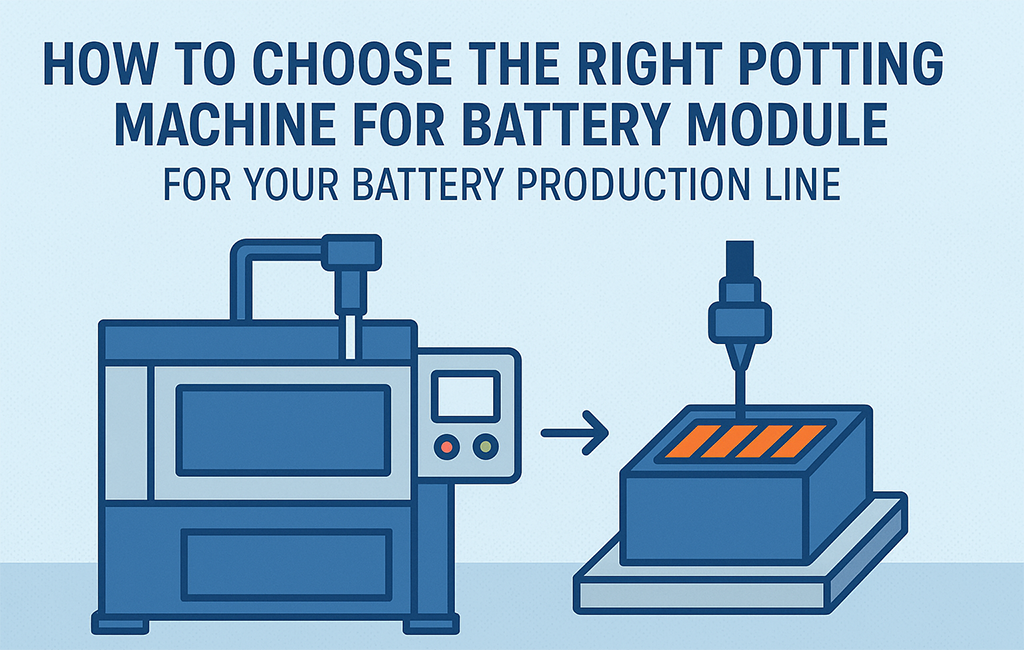
Selecting an appropriate potting machine for battery module assembly directly impacts thermal management performance, structural integrity, and production throughput. The encapsulation process requires precise material dispensing, controlled cure profiles, and integration with existing module assembly equipment.
This guide examines critical specifications, dispensing configurations, and process parameters for potting machines in battery module production. We’ll cover material compatibility requirements, throughput calculations, and quality control methods essential for reliable module encapsulation.
What is a Potting Machine for Battery Module Production?
A potting machine for battery module production dispenses thermally conductive encapsulants between cells, bus bars, and module housings. These systems typically feature precision metering pumps, heated material reservoirs, and programmable dispensing patterns to ensure complete coverage without air entrapment.
Modern battery potting equipment integrates material preparation, dispensing, and initial cure stages within automated production lines. Key subsystems include degassing chambers for two-component materials, mixing heads with static or dynamic elements, and vision systems for dispense path verification.
Key Specifications for Battery Module Potting Machines
Potting machine selection begins with understanding material properties and production requirements. The following specifications determine equipment suitability for specific module designs and manufacturing volumes.
| Specification | Typical Range | Application Notes |
|---|---|---|
| Dispensing Rate | 50-500 ml/min | EV modules: 200-300 ml/min; ESS modules: 100-200 ml/min |
| Mix Ratio Accuracy | ±1-3% | Two-component polyurethane: ±1%; Silicone: ±2-3% |
| Material Viscosity Range | 1,000-50,000 cP | Gap fillers: 5,000-15,000 cP; Structural potting: 20,000-40,000 cP |
| Pot Life Window | 5-60 minutes | Fast cure for high volume; Extended pot life for large modules |
| Positioning Accuracy | ±0.5-2.0 mm | Cell-to-cell gaps: ±0.5 mm; Perimeter sealing: ±1.0 mm |
| Working Area | 400×600 to 1500×800 mm | Passenger EV: 600×800 mm; Commercial EV: 1000×1200 mm |
| Material Temperature Control | 20-80°C | Reduced viscosity dispensing: 40-60°C |
| Vacuum Degassing Capability | -0.09 to -0.095 MPa | Critical for thermal interface materials |
Material Handling Systems
Material preparation directly affects potting quality and consistency. Drum unloading systems with follower plates prevent air incorporation during material transfer. Heated circulation loops maintain uniform temperature and viscosity throughout extended production runs.
Degassing chambers remove entrapped air from high-viscosity materials before dispensing. Continuous vacuum degassing systems process materials at 5-20 liters per hour, while batch systems handle 20-200 liter volumes for campaign production.
How to Calculate Required Dispensing Capacity?
Dispensing capacity depends on module design, material volume per module, and production takt time. Calculate total material volume including cell gaps, bus bar encapsulation, and perimeter sealing. Add 10-15% for purge cycles and material trapped in supply lines.
Volume Calculation Method
For prismatic cell modules, calculate gap filling volume using: V = n × (cell spacing × cell height × cell width), where n represents the number of gaps. Add bus bar encapsulation volume and housing perimeter seal volume for total material requirement per module.
Production capacity = (material volume per module + waste factor) / takt time. A 50 kWh EV module typically requires 800-1200 ml of potting compound with 3-5 minute takt times demanding 200-400 ml/min dispensing rates.
What are the Main Dispensing Technologies?
Potting machines employ various dispensing technologies based on material properties, accuracy requirements, and production volumes. Each technology offers specific advantages for different battery module configurations and potting compounds.
Volumetric Piston Dispensing
Positive displacement piston pumps provide accurate, repeatable dispensing for medium to high viscosity materials. Shot sizes range from 0.1-50 ml with ±1% accuracy. Servo-driven systems enable programmable flow profiles for complex dispensing patterns.
Progressive Cavity Pumps
Continuous flow dispensing using progressive cavity pumps suits long bead applications and large volume fills. These systems handle filled materials with thermal conductivity enhancers while maintaining consistent flow rates from 10-1000 ml/min.
Gear Pump Systems
Precision gear pumps deliver pulsation-free material flow for thin bond lines and precise edge sealing. Temperature-controlled pump heads maintain viscosity stability during extended production runs. Typical applications include cell-to-cooling plate interface layers.
Configuration Options for Different Module Types
Battery module diversity requires flexible potting equipment configurations. Cylindrical, prismatic, and pouch cell modules each present unique potting challenges addressed through specific machine configurations.
Cylindrical Cell Module Potting
Cylindrical modules require bottom-up filling to eliminate air pockets between cells. Multi-nozzle dispensing heads accelerate cycle times by filling multiple cell gaps simultaneously. Vacuum-assisted potting chambers ensure complete penetration in densely packed configurations.
Prismatic Cell Module Systems
Large-format prismatic modules benefit from gantry-style dispensing systems with extended X-Y travel. Programmable dispensing paths accommodate varying cell spacing and bus bar routing. Vision-guided systems compensate for cell position variations within tolerance stackup.
Pouch Cell Encapsulation
Pouch cell modules require gentle material application to prevent cell deformation. Low-pressure dispensing with flow rate ramping protects delicate cell edges. Frame potting applications use perimeter dispensing patterns with corner radius control.
Integration with Battery Production Lines
Potting machines must synchronize with upstream and downstream processes in automated battery production. Module conveyor systems, robotic handling, and cure ovens require coordinated control for efficient material flow.
Pre-Potting Requirements
Surface preparation ensures adequate adhesion between potting compounds and module components. Plasma treatment systems activate polymer surfaces, while primer application improves long-term durability. Module preheating to 40-60°C reduces material viscosity and improves flow characteristics.
Post-Potting Processing
Initial gel cure prevents material flow during module transport to final cure ovens. UV spot curing or heated platens achieve handling strength within 2-5 minutes. Full cure cycles range from 30 minutes at 80°C to 24 hours at room temperature depending on material chemistry.
Quality Control and Inspection Methods
Consistent potting quality requires in-process monitoring and post-dispense inspection. Material flow monitoring, vision inspection, and thermal imaging identify defects before value-added downstream processes.
In-Process Monitoring
Flow meters track dispensed volume with ±0.5% accuracy for closed-loop process control. Pressure sensors detect dispensing anomalies including clogged nozzles or material cure advancement. Temperature monitoring ensures material remains within specified viscosity ranges.
Post-Dispense Inspection
3D scanning systems verify complete gap filling and proper material height. Thermal cameras detect voids or incomplete wet-out in opaque materials. Ultrasonic inspection identifies subsurface defects in cured potting compounds.
Common Potting Defects and Troubleshooting
Understanding potential defects enables proactive process optimization and rapid troubleshooting. The following checklist addresses frequent potting challenges in battery module production.
Troubleshooting Checklist
- Air Entrapment: Increase vacuum degassing time; reduce dispensing speed; implement bottom-up filling
- Incomplete Filling: Verify material volume calculations; check for nozzle clogging; increase dispense pressure
- Material Separation: Confirm mix ratio accuracy; reduce material age; increase mixing intensity
- Poor Adhesion: Verify surface cleanliness; implement plasma treatment; check primer application
- Viscosity Drift: Stabilize material temperature; monitor pot life; adjust dispensing parameters
- Flow Marks: Optimize dispensing speed; adjust material temperature; modify nozzle design
- Cure Inhibition: Check contamination sources; verify mix ratio; confirm cure temperature profile
Safety Considerations for Potting Operations
Chemical handling and dispensing equipment present specific safety requirements. Two-component systems require segregated storage, spill containment, and appropriate PPE for operators.
Material Safety Requirements
Isocyanate-based polyurethanes demand respiratory protection and skin contact prevention. Automated dispensing reduces operator exposure while maintaining production efficiency. Emergency shower/eyewash stations must be accessible within 10 seconds of dispensing areas.
Equipment Safety Features
Light curtains protect operators from moving gantry systems. Enclosed dispensing areas with exhaust ventilation control vapor exposure. Automatic purge cycles prevent material cure within equipment during production interruptions.
Maintenance Requirements
Preventive maintenance schedules ensure consistent dispensing performance and extended equipment life. Daily, weekly, and monthly maintenance tasks address wear items and calibration requirements.
Daily Maintenance Tasks
Purge dispensing systems at shift end to prevent material cure in fluid paths. Clean nozzle tips and mixing elements according to material manufacturer recommendations. Verify dispensing accuracy with shot weight measurements.
Periodic Maintenance
Replace dynamic seals in pumps and valves based on cycle counts or calendar intervals. Calibrate flow meters and pressure transducers quarterly. Lubricate linear motion systems according to manufacturer specifications.
Conclusion
Selecting the right potting machine for battery module production requires careful evaluation of material properties, module design requirements, and production volumes. Key considerations include dispensing technology, accuracy specifications, and integration with existing production lines.
Successful implementation depends on matching equipment capabilities to specific application requirements while maintaining flexibility for future module designs. Regular maintenance and process monitoring ensure consistent quality throughout the equipment lifecycle.
Glossary
- Pot Life
- Working time available after mixing two-component materials before viscosity increase affects dispensing quality
- Takt Time
- Available production time divided by customer demand; determines required cycle time for each module
- Mix Ratio
- Volumetric or gravimetric proportion of resin to hardener in two-component dispensing systems
- Thermal Interface Material (TIM)
- Thermally conductive compound that fills gaps between cells and cooling systems
- Progressive Cavity Pump
- Positive displacement pump using helical rotor and stator for continuous, pulse-free material flow
- Shot Size
- Predetermined volume of material dispensed in a single cycle
- Follower Plate
- Seal plate that travels down drum interior to prevent air incorporation during material unloading
- Thixotropic Index
- Measure of material’s shear-thinning behavior; affects flow and leveling characteristics