


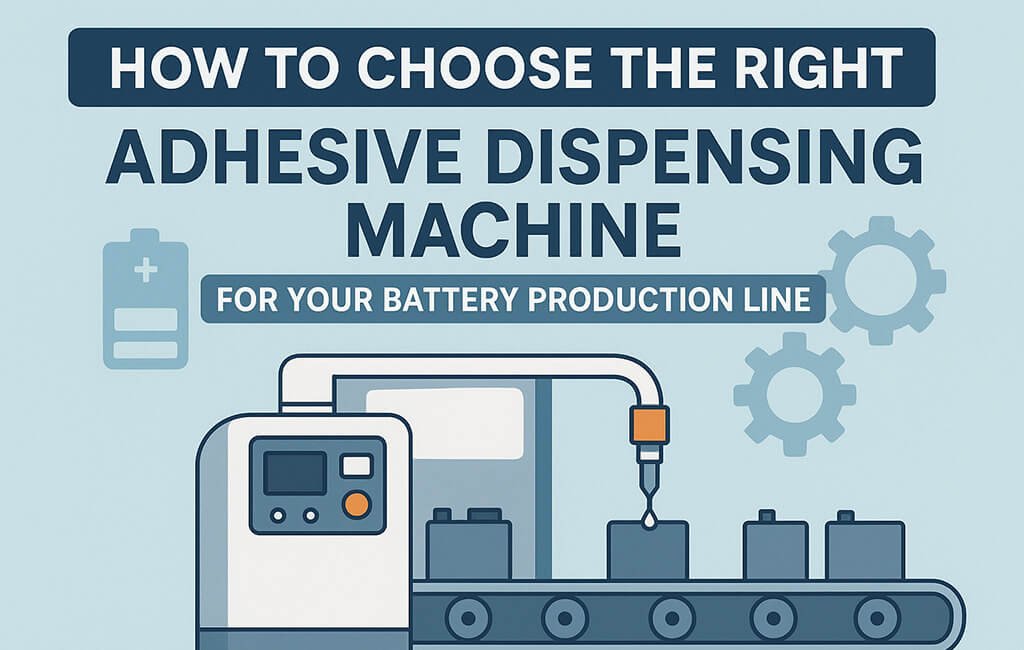
Selecting an adhesive dispensing machine for battery cell assembly requires careful evaluation of technical specifications, material compatibility, and production requirements. The dispensing system must deliver precise adhesive application while maintaining throughput targets and quality standards.
This guide examines critical selection parameters including dispensing accuracy, viscosity handling capabilities, and integration requirements for battery manufacturing environments. Understanding these factors ensures optimal adhesive application for electrode bonding, separator attachment, and cell sealing processes.
What Are the Key Specifications for Battery Production Adhesive Dispensing?
Battery manufacturing demands precise adhesive application with tolerances typically ranging from ±0.1mm to ±0.5mm depending on the specific application. Critical specifications include flow rate control, pattern repeatability, and material compatibility.
The dispensing system must handle various adhesive viscosities while maintaining consistent bead profiles and volumes throughout production runs.
| Specification Parameter | Typical Range | EV Battery Application | ESS Application | Consumer Electronics |
|---|---|---|---|---|
| Dispensing Accuracy | ±0.1-0.5mm | ±0.2mm for module assembly | ±0.3mm for pack sealing | ±0.1mm for pouch cells |
| Viscosity Range | 100-50,000 cP | 5,000-20,000 cP typical | 10,000-30,000 cP typical | 1,000-10,000 cP typical |
| Flow Rate | 0.1-100 ml/min | 5-50 ml/min | 10-80 ml/min | 0.5-20 ml/min |
| Pattern Speed | 10-500 mm/s | 50-200 mm/s | 30-150 mm/s | 100-400 mm/s |
| Positioning Repeatability | ±0.02-0.1mm | ±0.05mm | ±0.08mm | ±0.02mm |
| Working Area | 200×200-800x600mm | 400x400mm typical | 600x600mm typical | 300x300mm typical |
Adhesive Material Compatibility Requirements
Battery production utilizes various adhesive types including epoxies, polyurethanes, silicones, and acrylics. Each material presents unique dispensing challenges related to viscosity, pot life, and curing characteristics.
The dispensing system must accommodate single-component and two-component adhesives while maintaining material integrity throughout the process.
Single-Component Adhesive Systems
Single-component adhesives simplify the dispensing process but require precise temperature control. Common applications include electrode tab bonding and preliminary cell assembly.
Temperature management systems maintain adhesive viscosity within optimal ranges, typically 20-40°C for most battery adhesives. Heated dispensing valves and material reservoirs ensure consistent flow characteristics.
Two-Component Adhesive Systems
Two-component systems provide enhanced bonding strength and chemical resistance essential for battery pack assembly. These systems require precise mixing ratios and thorough blending before application.
Dynamic mixing systems combine components at ratios ranging from 1:1 to 10:1 with mixing accuracy of ±2%. Static mixers or dynamic mixing heads ensure homogeneous material distribution.
How Do You Determine Required Dispensing Patterns for Different Cell Types?
Dispensing patterns vary significantly based on cell format, assembly method, and performance requirements. Cylindrical cells typically require spiral or dot patterns, while prismatic and pouch cells need linear beads or area fills.
Pattern complexity influences equipment selection, with simple patterns requiring basic X-Y positioning while complex geometries demand multi-axis systems with rotation capabilities.
Cylindrical Cell Applications
Cylindrical cells require precise adhesive placement for separator attachment and can sealing. Typical patterns include circumferential beads with widths of 1-3mm and heights of 0.5-1.5mm.
Rotary dispensing attachments enable continuous bead application during cell rotation. Dispensing speeds range from 50-200mm/s depending on adhesive viscosity and cell diameter.
Prismatic Cell Applications
Prismatic cells utilize frame dispensing patterns for case sealing and electrode stack bonding. Rectangle patterns with corner radius control prevent adhesive accumulation at direction changes.
Multi-pass dispensing creates seal widths of 3-10mm with controlled overlap zones. Vision systems verify pattern placement accuracy before cell closure.
Pouch Cell Applications
Pouch cells demand precise edge sealing with minimal adhesive migration. Dispensing patterns follow cell perimeter with offsets of 2-5mm from edge boundaries.
Ultrathin bead profiles of 0.5-2mm width accommodate tight sealing zones. Low-pressure dispensing prevents adhesive spread during lamination processes.
Pressure Control Systems and Dispensing Methods
Accurate adhesive dispensing relies on precise pressure control throughout the application cycle. System selection depends on adhesive properties, required accuracy, and production volume.
Three primary pressure control methods serve battery production applications: pneumatic, servo-driven, and positive displacement systems.
Pneumatic Pressure Systems
Pneumatic systems provide cost-effective dispensing for low to medium viscosity adhesives. Air pressure regulation maintains flow rates with accuracy of ±5-10%.
Pressure ranges typically span 0.5-7 bar with electronic pressure regulators providing 0.01 bar resolution. Vacuum suck-back prevents adhesive dripping between dispense cycles.
Servo-Driven Systems
Servo-controlled dispensing delivers superior accuracy for high-viscosity adhesives and critical applications. Linear actuators or screw drives provide volumetric accuracy of ±1-2%.
Programmable acceleration and deceleration profiles minimize adhesive stringing. Force feedback monitors material flow resistance for process verification.
Positive Displacement Systems
Progressive cavity pumps and gear pumps enable continuous dispensing for high-volume applications. Flow rates remain consistent regardless of viscosity variations.
Volumetric accuracy reaches ±0.5% with proper calibration. Heated pump housings maintain optimal material flow for temperature-sensitive adhesives.
What Integration Features Are Essential for Battery Line Compatibility?
Modern battery production lines require seamless integration between dispensing systems and upstream/downstream processes. Communication protocols, safety interlocks, and data exchange capabilities determine integration success.
Clean room compatibility represents another critical requirement, with ISO Class 7 or better environments common in battery manufacturing.
Communication Protocols
Industrial ethernet protocols including EtherCAT, PROFINET, and EtherNet/IP enable real-time data exchange. PLC integration allows centralized process control and recipe management.
Digital I/O interfaces coordinate dispensing triggers with cell handling systems. Response times under 10ms ensure synchronized operation at production speeds.
Vision System Integration
Machine vision verifies adhesive placement accuracy and bead quality. Pre-dispensing alignment compensates for cell position variations of ±1-2mm.
Post-dispensing inspection detects missing beads, width variations, and pattern defects. Image data links to cell tracking systems for quality traceability.
Environmental Controls
HEPA filtration systems prevent particle contamination during dispensing operations. Laminar flow enclosures maintain ISO Class 5 conditions at dispense points.
Temperature and humidity monitoring ensures consistent adhesive properties. Environmental ranges typically span 20-25°C and 40-60% relative humidity.
Quality Control Parameters and Monitoring Systems
Continuous monitoring of dispensing parameters ensures consistent adhesive application throughout production runs. Key metrics include flow rate stability, pattern accuracy, and material consumption.
Statistical process control tracks parameter variations and triggers alarms for out-of-specification conditions.
Flow Rate Monitoring
Mass flow sensors or volumetric measurements verify adhesive delivery rates. Acceptable variations typically remain within ±5% of target values.
Trend analysis identifies gradual changes indicating filter clogging or viscosity shifts. Automatic compensation adjusts pressure or speed parameters to maintain flow targets.
Pattern Verification Systems
Laser triangulation sensors measure bead height and width during dispensing. Real-time feedback enables immediate correction of dimensional variations.
3D scanning systems create complete adhesive profile maps for critical applications. Measurement resolution reaches 0.01mm for precise quality documentation.
Material Tracking
Adhesive consumption monitoring prevents unexpected material depletion. Level sensors in reservoirs trigger refill alerts at predetermined thresholds.
Lot tracking systems record adhesive batch information for each dispensed pattern. Barcode scanning links material data to individual cells or modules.
Maintenance Requirements and Preventive Care Procedures
Regular maintenance ensures consistent dispensing performance and extends equipment life. Maintenance intervals depend on adhesive type, production volume, and environmental conditions.
Documented procedures standardize maintenance activities and minimize process variations.
Daily Maintenance Tasks
Nozzle cleaning removes adhesive residue that affects pattern quality. Purge cycles at shift start clear settled material from fluid paths.
Visual inspection identifies wear on seals, fittings, and dispensing tips. Calibration verification confirms dispensing accuracy remains within specifications.
Weekly and Monthly Procedures
Filter replacement prevents pressure fluctuations from clogged elements. Typical intervals range from 500-2000 operating hours depending on adhesive type.
Lubrication of linear guides and ball screws maintains positioning accuracy. Backlash measurements verify mechanical tolerances remain acceptable.
Annual Overhauls
Complete valve rebuilds restore original dispensing performance. Seal kit replacements prevent adhesive leakage and pressure loss.
Controller calibration and software updates ensure continued compatibility with production systems. Backup parameter sets protect against data loss during maintenance.
Troubleshooting Common Dispensing Issues
Systematic troubleshooting procedures minimize production disruptions from dispensing problems. Understanding root causes enables rapid corrective actions.
- Inconsistent bead size: Check pressure stability, nozzle wear, and material viscosity changes
- Adhesive stringing: Adjust suck-back parameters, reduce traverse speed, or modify material temperature
- Pattern position errors: Verify axis calibration, check mechanical backlash, confirm vision alignment
- Material separation: Increase mixing intensity, check component ratios, verify material shelf life
- Nozzle clogging: Implement regular purge cycles, check filter condition, verify material compatibility
- Adhesive bubbles: Degas material before use, check vacuum levels, reduce dispensing speed
- Intermittent flow: Inspect check valves, verify air supply pressure, check for partial blockages
- Adhesive contamination: Review material handling procedures, check environmental controls, inspect storage conditions
Nozzle Selection and Configuration Options
Nozzle geometry significantly impacts dispensing quality and pattern characteristics. Selection criteria include adhesive viscosity, required bead dimensions, and substrate geometry.
Standard nozzle types serve most battery applications, while custom designs address unique requirements.
Tapered Tip Nozzles
Conical nozzles with included angles of 15-90 degrees provide versatile dispensing options. Smaller angles create fine beads for precision applications.
Internal diameters range from 0.1-3.0mm with length-to-diameter ratios of 3:1 to 10:1. Polypropylene or stainless steel construction resists adhesive buildup.
Flat Tip Configurations
Rectangular orifices produce wide, flat beads for area coverage applications. Typical dimensions span 0.5-5.0mm width and 0.1-1.0mm height.
Orientation control maintains consistent bead profiles during direction changes. Anti-rotation features prevent nozzle movement during operation.
Specialty Nozzle Designs
Coaxial nozzles enable simultaneous two-component dispensing with mixing at the point of application. Brush nozzles spread adhesive while dispensing for coating applications.
Heated nozzles maintain adhesive temperature for hot-melt applications. Temperature ranges typically span 40-200°C with ±2°C control accuracy.
Cycle Time Optimization Strategies
Reducing dispensing cycle times improves production throughput without compromising quality. Optimization focuses on motion efficiency, parallel processing, and rapid material handling.
Baseline cycle time measurements establish improvement targets and identify bottleneck operations.
Motion Path Optimization
Continuous path planning eliminates unnecessary acceleration/deceleration cycles. Corner rounding maintains constant velocity through direction changes.
Look-ahead algorithms calculate optimal trajectories for complex patterns. Spline interpolation creates smooth transitions between pattern segments.
Multi-Head Configurations
Dual or quad dispensing heads enable simultaneous pattern creation. Independent Z-axis control accommodates height variations across large substrates.
Shared material supply systems reduce setup time between production runs. Quick-change mounting systems facilitate rapid head swaps for different adhesive types.
Process Integration Features
Conveyor synchronization allows dispensing during substrate movement. Encoder feedback maintains pattern accuracy at variable transport speeds.
Pre-staging positions reduce idle time between dispense cycles. Automatic tool changers swap nozzles without operator intervention.
Conclusion
Selecting the right adhesive dispensing machine requires thorough evaluation of technical specifications, material compatibility, and integration requirements. Understanding dispensing accuracy needs, viscosity handling capabilities, and production environment constraints guides equipment selection.
Successful implementation depends on matching equipment capabilities to specific battery production requirements while maintaining flexibility for future process changes. Regular maintenance and systematic troubleshooting procedures ensure consistent performance throughout the equipment lifecycle.
Glossary
- Dispensing Accuracy
- The precision with which adhesive placement matches programmed positions, typically measured in millimeters or percentage of target values
- Viscosity Range
- The span of material thickness values (measured in centipoise) that dispensing equipment can successfully process while maintaining flow control
- Suck-Back
- Reverse pressure or vacuum applied after dispensing to prevent adhesive dripping by retracting material within the nozzle
- Progressive Cavity Pump
- A positive displacement pump using a helical rotor within a stator to create precise volumetric flow regardless of pressure variations
- Dynamic Mixing
- Active blending of two-component adhesives using mechanical agitation or motionless mixer elements during the dispensing process
- Pattern Repeatability
- The consistency of adhesive bead placement across multiple dispensing cycles, critical for maintaining quality in high-volume production
- Clean Room Compatibility
- Equipment design features that prevent particle generation and allow operation within controlled environment classifications
- Flow Rate Compensation
- Automatic adjustment of dispensing parameters to maintain consistent adhesive delivery despite viscosity or temperature variations